Essential Gear For New RVers

If you’re a new RVer and are about to get on the road or recently hit the road, will your RV already come with everything you need?
The answer is most likely not, unless you bought it used and the former owner graciously included a bunch of things. Even then, there’s probably some essential gear for new RVers you need or will want to upgrade.
We got on the road to RV fulltime in 2018, and we know from experience that there were quite a few things we had to buy right away to be able to RV, to make sure we were safe on the road, and to help us fully enjoy the experience.
Here are 14 items that you’ll need for your RVing experience that you should consider getting either immediately or fairly quickly.
If you prefer video, click below to let us show you the gear we recommend!
We’d love it if you’d like to subscribe to us on YouTube also!
DISCLAIMER: Never Stop Adventuring contains links to affiliate websites and is a member of the Amazon Services LLC Associates Program. When you click on and/or make a purchase through an affiliate link placed on our website, we may receive a small commission or other form of compensation at no additional cost to you. Please read our disclaimer for more info.
Item #1: Leveling blocks
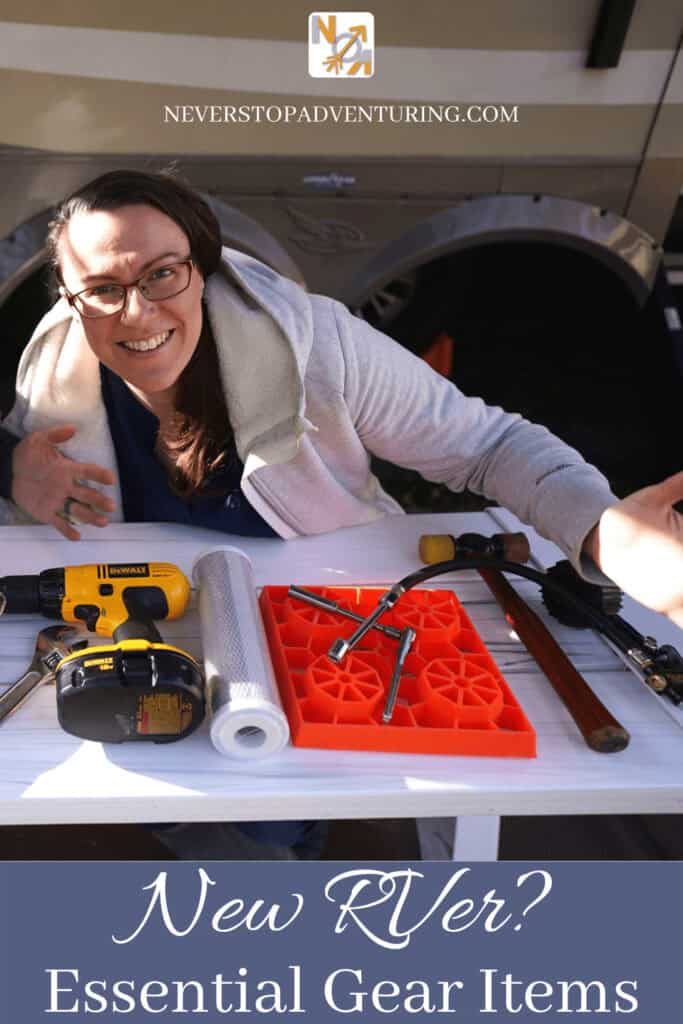
Sometimes you get lucky and your spot is perfectly level, but this is usually not the case. Grab a couple sets of Lynx levelers or Camco leveling blocks because sometimes one won’t cut it.
This will let you put your jacks down on the blocks so you’re less likely to sink into the ground or even damage a concrete pad, and then build them up under whichever side you might need to prop up some. You definitely don’t want to be unlevel.
You can even build a little platform with them to put one set of wheels on if things are pretty off from side to side.
Item #2: Wheel chocks
Wheel chocks you’ll need to put around your wheels to make sure your RV won’t roll anywhere, especially as you are hitching or unhitching. Again we like Lynx wheel chocks or Camco wheel chocks.
It’ll keep your RV in place and give you peace of mind. Another great option are X-Chocks. They go between your tires and expand outward like a jack to lock them both in place.
Item #3: Tool box with basic tools
Things are going to come up that you will need to fix, adjust, or just do regular maintenance on. Make sure your toolbox has some basic items for everyday repairs and maintenance.
When looking at our toolbox, I’d say this should probably include some sockets, screwdrivers, a hammer, pliers, and an adjustable wrench at minimum. A couple other nice to have items might be: a clamp/multimeter, and a cordless drill.
Item #4: Freshwater hose & extension
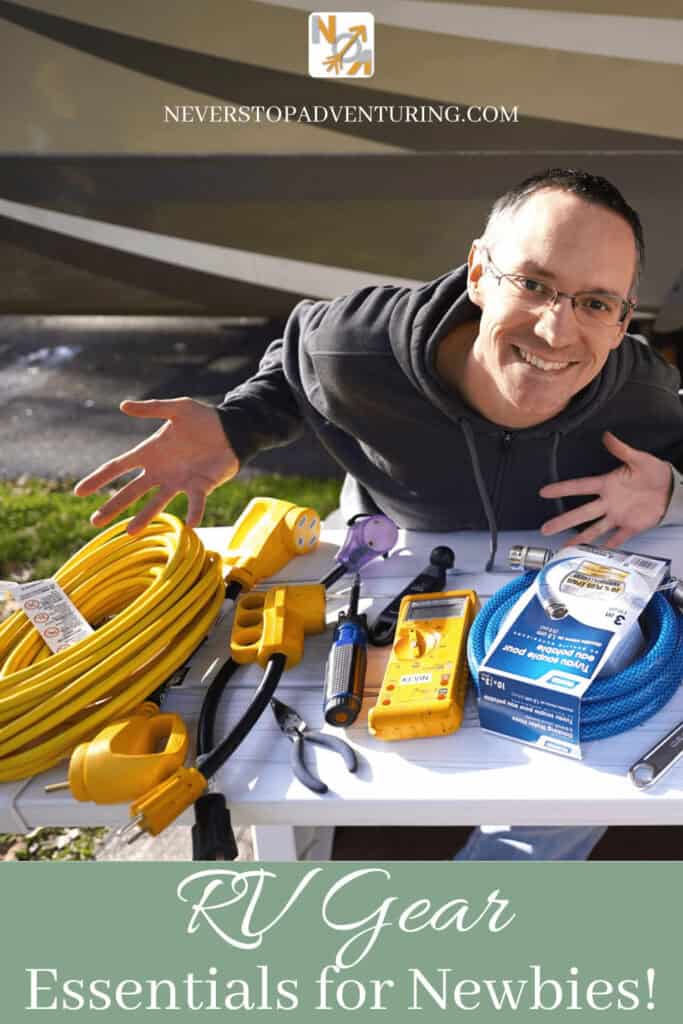
Make sure you have an RV freshwater hose. We personally prefer the Camco ones. We like the blue ones better than the white ones.
Whichever you choose, we recommend you get the hose as well as an extension because sometimes you are further from a spigot than your one length of hose can reach. Aim for a total length of about 50ft.
Item #5: Water pressure regulator
A water pressure regulator is a must because sometimes the water pressure is really high at campgrounds and without one it can damage your RV’s plumbing and cause leaks.
We recommend an adjustable one with a gauge rather than just the regular cheap passive one so you can control and monitor the water pressure coming into your rig.
Item #6: Sewer Hose with an elbow
Get yourself a nice one, like a Camco RhinoFLEX which compress and are crush resistant. That way you can store it away more easily and it should hold up better. Get a threaded elbow so you can get a better fit to the sewer port.
You can decide if you want the clear elbow or not. Some people like to see the water run clear when they’re dumping and rinsing their waste tanks, but some people think it’s really gross. We’ve had both and don’t really care either way.
We have two sewer hoses that are each 10 ft. long. We recommend 2 lengths of sewer hose to make sure you can reach the sewer port if it’s a little further away.
We’ve personally never needed more than 2 to reach in a campground, but we have used 5 of them together to reach a sewer port when moochdocking before!
Item #7: Extension cords
As we mentioned with both water and sewer connections previously, there might also be a time where your electrical cord doesn’t reach. So get another 25 ft. or so extension cord that’s either a 50 amp extension cord or a 30 amp extension cord depending on your rig.
Also get a 20 amp heavy duty extension cord and RV electrical adaptors for the cords (like 50 to 30, 50 to 15, 30 to 15, depending on what you have) so then you’ll be prepared to get power in whatever situation you find yourself in.
Item #8: EMS surge protector
EMS stands for Electrical Management System and while it’s a bit more expensive than a standard surge protector, I wouldn’t go with anything less. It is crucial to protect from electrical problems from the pedestal or outlet you are plugged into.
Stopping a power surge is important, but a full blown EMS takes it several steps further and protects against things like reverse polarity (that’s when the outlet isn’t wired the right way), and most importantly: when the voltage is too high or too low.
A regular surge protector won’t do that and we have not been through a single year where we haven’t run into voltage problems at campgrounds! Be sure to get either a 50 amp EMS surge protector or a 30 amp EMS surge protector depending on your rig.
Item #9: Digital tire pressure gauge
These next 3 items are all about tires, which are incredibly important to safety while travel.
You want to be able to easily check all of your tire pressures before you hit the road. Having a digital tire pressure gauge is a must and makes it easy.
If you need to, get one with a longer stem so you can reach the inner tires if you have a dually truck for example.
Item #10: Portable tire inflator
After you’ve checked your tire pressures you might need to add some air.
Sure you might say you can just go to a gas station, but it’s much safer and easier if you have a portable RV tire inflator to be able to do that before you go anywhere. That way you also don’t risk having to drive a long way and then the air station you find potentially not being able to inflate your tires to the correct pressure. It’s just easier to get one yourself.
Consider if you’re filling car, truck, and/or RV tires & what PSI is needed when selecting one to buy.
Item #11: Tire pressure monitoring system
Having a Tire Pressure Monitoring System that monitors your tire pressure and immediately lets you know if something is going on as you’re traveling is also really important.
Being able to catch a tire just starting to go flat is a lot easier situation to handle than a tire that has just exploded and having to try to safely navigate to the side of the road to change the flat tire and deal with all the potential damage caused.
There are several brands and systems out there but definitely get one to monitor all your tires.
Item #12: Water filter(s)
As you’re traveling you never know what kind of water quality you’re going to get. Mineral concentrations especially seem to vary a lot around the country. Sometimes it can taste pretty bad or have a bad odor.
Getting an in-line water filter from Camco or a Clearsource filter system is an easy way to help with this. It will just go in-line with the hose between the water spigot and your RV.
We’ve used these over the years but for our current rig we also have a built-in whole house filter as well as a fridge filter, and it’s definitely important to know you have good drinking water.
Item #13: Sealable tubs
Sealable tubs can help keep things organized in your storage bays. It’s really helpful to keep things contained so things don’t end up all over the place. If they are clear tubs you can also see what is inside them to find things easier.
We recommend you have at least one for freshwater hoses & another for your sewer pipe. After that you could have a tub or tubs for various other things like outdoor cooking & dining gear or kids toys for example.
Item #14: Organizational Items
Getting some basic organizational items when you first move in and get started will help you find a place for everything, keep it secure during bumpy travels, and be able to more easily find it all.
Get a feel for where you plan to put things as you are moving in, and take measurements of some of the spaces and write them down. Think about how things may move and shift as you travel down the road and where they may bump together and break or get all jumbled up.
Consider spaces where you might want to fit more things into a smaller space, as well as areas that may be deep and narrow or otherwise odd shaped and difficult to access easily. These are the spaces you may want to add some extra organizational items.
For example, kitchen pantry space for spices and other items, cabinets for glasses and dishware, closet space for clothing, bathroom mirror cabinet and linen closet space, and so on!
We really like Ikea and The Container Store for various organizational items!
More Gear For New RVers We Didn’t Mention Above
Here’s a list of other ideas:
- Hitch Setup / Tow Setup
- Internet Connectivity
- Lube Plate
- Trash cans
- Vacuum cleaner
- Door Mat
- Portable fire extinguisher and spare(s)
- Step stool
- 90 Degree Brass Elbow for freshwater hookup
- Command Hooks
- Brake system for tow vehicle
- Roadside Emergency Flashing Light & cone kit
- Quality Flashlight(s) and/or headlamp
- 360 degree bubble level
- RV toilet drop-in cleaners
Those are tips for some of the items that new RVers should get! We hope this helps you get on the road and enjoy the RV life!
If you liked this post, would you share it with friends? Thank you!
Pin For Later: